會訊(第二十八期)
出版日期: 二○○六年七月一日
自由講場
出版日期: 二○○六年七月一日
自由講場

電郵Email:club@qqclub.org 電 傳Fax:(852) 2835 7777
34 Oi Kwan Road, Wanchai, Hong Kong
| |
|
會訊(第二十八期)
出版日期: 二○○六年七月一日 自由講場 |
| |
||
| 香港灣仔愛群道34號 電
話Phone:(852) 2574 4296 電郵Email:club@qqclub.org 電 傳Fax:(852) 2835 7777 34 Oi Kwan Road, Wanchai, Hong Kong |
 |
 |
 |
 |
 |
 |
 |
 |
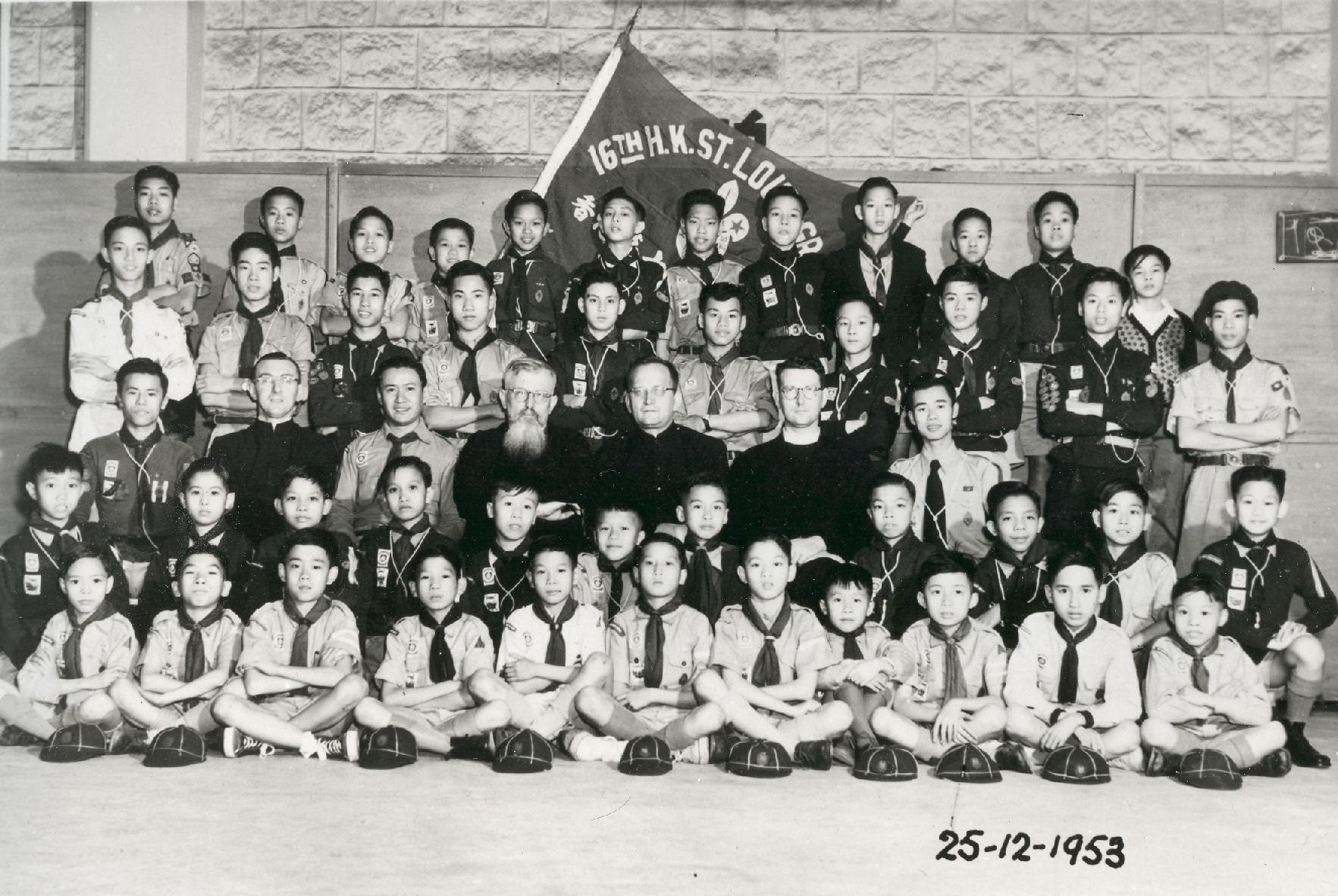
港島第16旅的早年歷史 |
|||||
| 李鐵擎 |
|||||
|
|||||
| Dear Scout Brothers of 16th HKG, 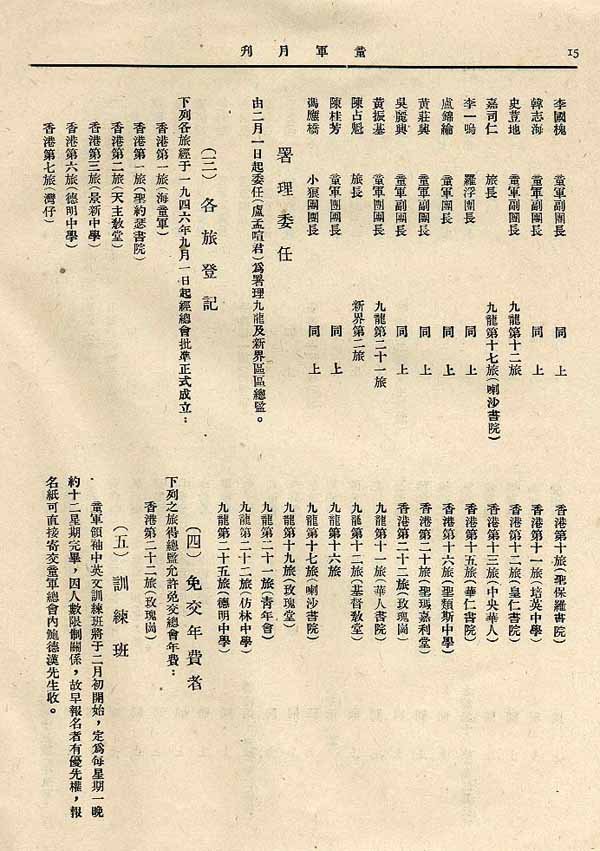 Thanks for your interest in the history of 16th Hong Kong (St. Louis
School) Scout Troop/Group with an enquiring mind. If we put occurrence
of more than a half-century ago into a span of twenty-four-hour
happening today, this would seem a cutting-edge research. But, to
resume the original designations of the past in every text is more
appropriate to show their reality in the history. In pursuance of the
Policy, Organization and Rules (POR) in 1924 which had been adopted for
many years in Hong Kong; Cub Packs, Scout Patrols and Rover Patrols
were troops under District Commissioners, Colony Commissioner and Chief
Scout of Hong Kong, and administered by a Special Commissioner for
overseas at the Imperial Headquarters (IHQ) in London. In this POR it
also mentioned that "In this Chart, the word Troop indicates the
complete Scout unit, viz:- A Cub Pack, Scout Troop and Rover Patrols".
This meant any scout unit consisted of one Scout Troop and/or one Cub
Pack and/or a number of Rovers. In 1949 when I first attended the scout
troop meeting in the 16th, I found a green wooden broad written with
"16th Hong Kong (St. Louis) Troop" in yellow words hung on the wall.
Undoubtedly, 16th Hong Kong Scout Troop was established before 1940 or
earlier by an Englishman named Green Shaw, and it became a scout
"Group" afterwards. We cannot eliminate the possibility that Mr. Green
Shaw was a member of the 16th Rover Patrol from Taikoo Dockyard located
in Quarry Bay, North Point, Hong Kong in 1920, and he might be one of
the founders of the 16th Roman Catholic Rovers (later became 2nd Hong
Kong Group). In those days, registration for a scout troop took a very
long time by getting recommendation through the Hong Kong Branch to
IHQ, so as the appointment of Scout Master from IHQ. The simplest way
was to carry 16th in different places one after another. Another
example of change was the oldest 3rd Hong Kong (St. Andrew's Church)
Troop became the 1st Kowloon Group after the "Colony" of Hong Kong was
divided into administrative "Districts". In my opinion, the
establishment of our scout unit in St. Louis School is more important
than we need to clarify the given number 16th to St. Louis scouts in
our research. Let us continue our traditional campfire every year and
to celebrate our 67th Anniversary in 2006 in memory of our founder Mr.
Green Shaw in St. Louis.
Thanks for your interest in the history of 16th Hong Kong (St. Louis
School) Scout Troop/Group with an enquiring mind. If we put occurrence
of more than a half-century ago into a span of twenty-four-hour
happening today, this would seem a cutting-edge research. But, to
resume the original designations of the past in every text is more
appropriate to show their reality in the history. In pursuance of the
Policy, Organization and Rules (POR) in 1924 which had been adopted for
many years in Hong Kong; Cub Packs, Scout Patrols and Rover Patrols
were troops under District Commissioners, Colony Commissioner and Chief
Scout of Hong Kong, and administered by a Special Commissioner for
overseas at the Imperial Headquarters (IHQ) in London. In this POR it
also mentioned that "In this Chart, the word Troop indicates the
complete Scout unit, viz:- A Cub Pack, Scout Troop and Rover Patrols".
This meant any scout unit consisted of one Scout Troop and/or one Cub
Pack and/or a number of Rovers. In 1949 when I first attended the scout
troop meeting in the 16th, I found a green wooden broad written with
"16th Hong Kong (St. Louis) Troop" in yellow words hung on the wall.
Undoubtedly, 16th Hong Kong Scout Troop was established before 1940 or
earlier by an Englishman named Green Shaw, and it became a scout
"Group" afterwards. We cannot eliminate the possibility that Mr. Green
Shaw was a member of the 16th Rover Patrol from Taikoo Dockyard located
in Quarry Bay, North Point, Hong Kong in 1920, and he might be one of
the founders of the 16th Roman Catholic Rovers (later became 2nd Hong
Kong Group). In those days, registration for a scout troop took a very
long time by getting recommendation through the Hong Kong Branch to
IHQ, so as the appointment of Scout Master from IHQ. The simplest way
was to carry 16th in different places one after another. Another
example of change was the oldest 3rd Hong Kong (St. Andrew's Church)
Troop became the 1st Kowloon Group after the "Colony" of Hong Kong was
divided into administrative "Districts". In my opinion, the
establishment of our scout unit in St. Louis School is more important
than we need to clarify the given number 16th to St. Louis scouts in
our research. Let us continue our traditional campfire every year and
to celebrate our 67th Anniversary in 2006 in memory of our founder Mr.
Green Shaw in St. Louis. Thanks to Mr. Yu (余敏聰先生) and Mr. Ng (吳兆康先生). Their Article in Hong Kong Scouting Volume 262 Feb 2006 noted down that 16th HKG was among the first 9 units to resume scout activity in 1946. As far as I know that for a very short period immediately after the WWII, the Hong Kong Scout Headquarters was once in St. Louis School. 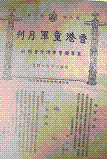 The
Hong Kong
Scouting Gazette was printed by St. Louis Industrial School (Hong Kong
Scouting Volume 250 Feb 2005). The
Hong Kong
Scouting Gazette was printed by St. Louis Industrial School (Hong Kong
Scouting Volume 250 Feb 2005). 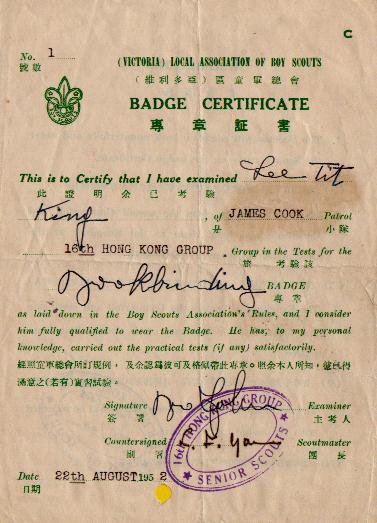 When
time before and after the World War
II, our school teacher Bro. John in the printing department of St.
Louis was the Hong Kong scout badge examiner for Bookbinder and
Printer. In this connection, all scouts of 16th got their examination
for the first badge of Bookbinder or Printer. In the Hong Kong
scouting, several years after 1949 was a transitional period for Scouts
becoming Senior Scouts. I got the Bookbinding badge from Bro. John and
it was countersigned by my Senior Scout Master Mr. Yau Kwok Fai(邱國輝先生),
a Woodbadge holder in 1951 (Hong Kong Scouting Volume 240 Apr 2004).
However, in the latter years, the Bookbinding badge for senior scouts
had been deleted. Moreover, I want to add here that the Woodbadge
courses before 1951 were in English for attendance coming from all over
the world run by IHQ. For this reason, only 6 Chinese were able to
attend this course. With same method of training of scouters, I
attended the Woodbadge course in 1956. This English course was also for
international scouters held in Chaiwan campsite. Our 16th owned its
campsite in Chaiwan. Even though this Chaiwan island was so small but
it could accommodate up to more than 12 Scout Groups for their own use
in local Jamboree. This is one of the landmarks in the history that can
be an evidence to prove the existence of 16th for 67 years in the past. When
time before and after the World War
II, our school teacher Bro. John in the printing department of St.
Louis was the Hong Kong scout badge examiner for Bookbinder and
Printer. In this connection, all scouts of 16th got their examination
for the first badge of Bookbinder or Printer. In the Hong Kong
scouting, several years after 1949 was a transitional period for Scouts
becoming Senior Scouts. I got the Bookbinding badge from Bro. John and
it was countersigned by my Senior Scout Master Mr. Yau Kwok Fai(邱國輝先生),
a Woodbadge holder in 1951 (Hong Kong Scouting Volume 240 Apr 2004).
However, in the latter years, the Bookbinding badge for senior scouts
had been deleted. Moreover, I want to add here that the Woodbadge
courses before 1951 were in English for attendance coming from all over
the world run by IHQ. For this reason, only 6 Chinese were able to
attend this course. With same method of training of scouters, I
attended the Woodbadge course in 1956. This English course was also for
international scouters held in Chaiwan campsite. Our 16th owned its
campsite in Chaiwan. Even though this Chaiwan island was so small but
it could accommodate up to more than 12 Scout Groups for their own use
in local Jamboree. This is one of the landmarks in the history that can
be an evidence to prove the existence of 16th for 67 years in the past.
The names appeared in the Hong Kong Scouting Gazette Feb 1941 showed that 8 scouts from 16th HK got the "Ambulance" badge (Hong Kong Scouting Volume 252 Apr 2005). Two of them were Mr. Yau Kwok Fai (邱國輝先生) and Mr. Chan Kin Chuen (陳健全先生), who was once my Scout Master in St. Louis and later he became the first GSM of 17th Hong Kong Group of Salesian School in 1950. Another story was related to the Hong Kong scouts and the 16th during the wartime in Hong Kong. On the morning of Dec 7, 1941 the Canadian force was ferried across from Kowloon, some relocated from Gin Drinker's Line in Shing Mun Redoubt at Shing Mun Reservoir area to the Hong Kong island, and by 5 p.m. the battalions were in position and Brigadier Lawson's headquarters was set up at Wong Nei Chung Gap in the middle of the island. Fifteen hours before the Japanese attack, all Hong Kong defense forces were in position. Mr. F.E. Quah (柯昭璋先生) our Hong Kong Colony Commissioner (1950/53), and Mr. D.W. Luke (陸榮生先生) our Hong Kong Colony Commissioner (1953/1954) were in the Hong Kong Volunteer Defense Corps. They were seriously wounded. Two members of our 16th scouts were killed during the fiercest attack by the Japanese near the area of Wong Nei Chung Gap as they were serving in the despatch units. After the war, our 16th Hong Kong Group Scout Master Mr. Wong Tin Hung (王天熊先生) was awarded an authorized medal ribbon borne on the left breast in scout uniform because he had once belonged to the Air Raid Precautions Service (ARPS) in the wartime. 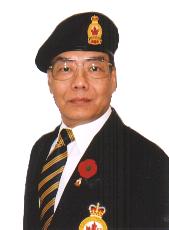 Today, one
of our 16th old scouts Mr. Ip (葉文銳) and myself have joined the Royal
Canadian Legion in Branch No.240 of White Rock in BC and serve the war
veterans in this region in redeeming the cost of defense of Hong Kong.
Approximately 290 Canadian soldiers were killed in battle and, while in
captivity, approximately 267 more died as prisoners of war (POW's), for
a total death toll of 557. In addition, almost 500 Canadians were
wounded. Of the 1,975 Canadians who went to Hong Kong, more than 1,050
were either killed or wounded. This was the casualty rate of any
Canadian theater of action in the Second World War (information taken
from the Veterans Affairs Canada.) Mr. Ip's wartime experience was the
first Japanese attack in Jardine's Lookout in Hong Kong Island while I
was under the Japanese air bombing near the Sham Shui Po Barrack in
Kowloon. The story of 16th, in part or in a whole, is worthwhile
devoted to short talks at hopefully every meeting when a leader has a
chance to say something special. Today, one
of our 16th old scouts Mr. Ip (葉文銳) and myself have joined the Royal
Canadian Legion in Branch No.240 of White Rock in BC and serve the war
veterans in this region in redeeming the cost of defense of Hong Kong.
Approximately 290 Canadian soldiers were killed in battle and, while in
captivity, approximately 267 more died as prisoners of war (POW's), for
a total death toll of 557. In addition, almost 500 Canadians were
wounded. Of the 1,975 Canadians who went to Hong Kong, more than 1,050
were either killed or wounded. This was the casualty rate of any
Canadian theater of action in the Second World War (information taken
from the Veterans Affairs Canada.) Mr. Ip's wartime experience was the
first Japanese attack in Jardine's Lookout in Hong Kong Island while I
was under the Japanese air bombing near the Sham Shui Po Barrack in
Kowloon. The story of 16th, in part or in a whole, is worthwhile
devoted to short talks at hopefully every meeting when a leader has a
chance to say something special. 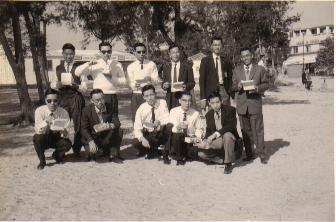 Mr. Ng
(吳兆康先生) is one of my best friends in scouting. This photo,
taking in 1963 at Repulse Bay, was a Senior Scouters Meeting for
raising fund. During this meeting, Hung Chiu On proposed a formation of
a "Queen's Scout Club" as there were many Queen's scouts had been
getting together in this meeting. Standing from left: Vicky Chan Wing
Kai (2nd), James Lee Tit King (3rd), Ying Pak Ling (4th), Hong Po Sum
(5th), Ng Shiu Hong (6th). In front from left: Wong Shiu Kwong (1st),
Jerry Lam Shung Lai (2nd), Hung Chiu On (3rd), Shek Yiu Joe (4th). Mr. Ng
(吳兆康先生) is one of my best friends in scouting. This photo,
taking in 1963 at Repulse Bay, was a Senior Scouters Meeting for
raising fund. During this meeting, Hung Chiu On proposed a formation of
a "Queen's Scout Club" as there were many Queen's scouts had been
getting together in this meeting. Standing from left: Vicky Chan Wing
Kai (2nd), James Lee Tit King (3rd), Ying Pak Ling (4th), Hong Po Sum
(5th), Ng Shiu Hong (6th). In front from left: Wong Shiu Kwong (1st),
Jerry Lam Shung Lai (2nd), Hung Chiu On (3rd), Shek Yiu Joe (4th). Hoping this information will serve those who have interest to know about 16th HKG. YIS James Lee Tit King. |
|
Copyright
© 2002-6, Queen's Scout (HKI) and
Queen's Guide Club
Web hosting sponsored by www.ayebiz.com Last modified on August 1, 2006 If you experience any problems with this site, please contact our webmaster webmaster@qqclub.org. |